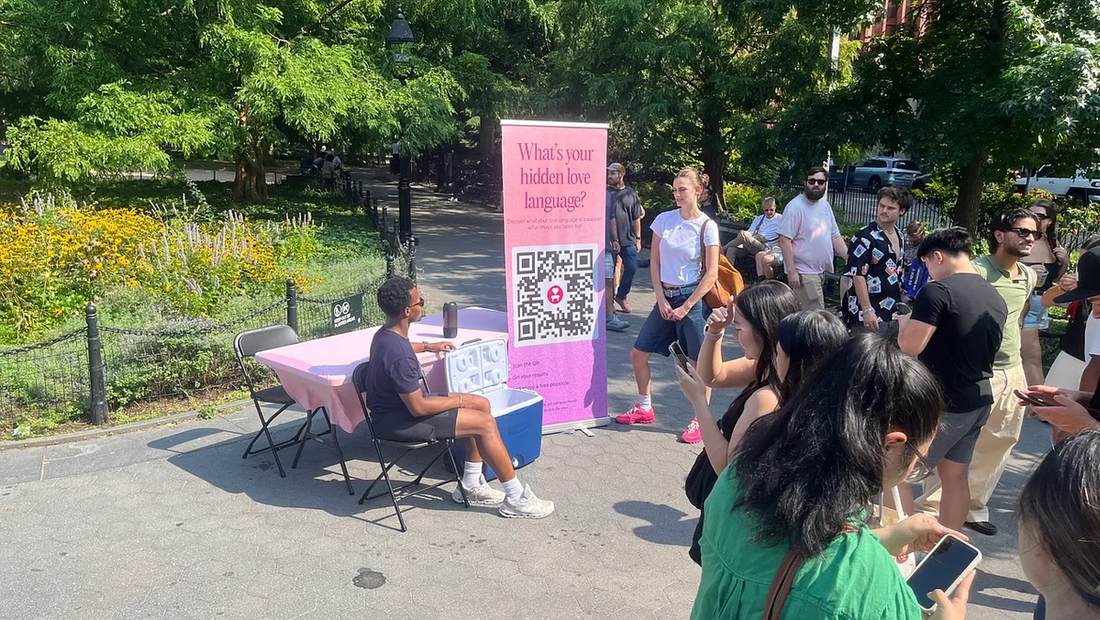
For most of his life, Micah dreamed of building something that helped make people connect. Sticky notes filled with random ideas and half-formed concepts were plastered on his wall, desperately trying to make sense of something he couldn’t define yet.
After going through the perfect storm of being laid off from his job, a breakup, and a health scare, Micah found himself in a state of feeling that has become all too common in the era of social media: feeling alone in a room filled with people. Going out every weekend, he realized that his interactions were way too surface-level to ever be called organic. Until one night, at a mom-and-pop burger spot in the East Village, a Frank Ocean song would introduce him to someone who would change the way he approached organic relationships.
At that point, an important question arose: “Why is it so difficult to meet people in natural, low-pressure ways?” The most interesting thing is that the interaction itself wasn’t special; it was how rare it was. One unexpected encounter became the glue that would connect his wall filled with sticky notes. Micah, with the help of some friends, would create an app to connect people based on their musical tastes.
What Did Early Ligo Look Like?
The concept of Ligo is a little bit of a paradox in itself: a social app that promotes not being on the app. But this concept was the most important part of his vision. Social media apps have studied behavioral science and dopamine patterns to design algorithms that keep us scrolling for hours.
The first version of Ligo was a real-time, one-to-one connection app. If someone close to you shared your music taste, both of you would get a notification. From there, if both people accept the invite, they get connected. So, what is the difference between Ligo and other platforms? No meaningless notifications or endless chat threads, Ligo was built to facilitate in-person, or IRL, as our generation coined, organic interactions.
Cracks in the foundation
As most founders and entrepreneurs know, it’s never all sunshine and rainbows. Other co-founders who were deeply involved stepped away at different points, which, in a way, forced Micah to rethink everything and question what resilience looks like in practice. There was a deep need to evaluate his interest and commitment to Ligo as a vision, not a product.
“There’s a difference between interest and commitment. When you’re interested in something, you do it only when it’s convenient. When you’re committed, you accept no excuses.” - Kenneth Blanchard
The Cost of Conviction
For Micah and many other highly committed founders, financial stability is one of the first things that gets sacrificed. But as nights and weekends blur together, time with friends becomes less frequent, and little joys become a tradeoff, he stopped thinking of sacrifice. This question is ultimately one everyone asks themselves: What is the cost of chasing your dream, pursuing something you truly believe in?
Chasing his dream of building Ligo indirectly helped him. It was his therapy. After stretches of uncertainty, Micah realized the importance of staying grounded in his values and taking care of his own health. He feels content in a way he never did before, and has found solace in building from a place where he already feels whole.
What does success look like?
For Micah, success doesn’t happen until Ligo is an essential part of how people connect, starting with the place where most lifelong friendships start, college campuses. It should be present in real moments when people meet and form relationships.
If it worked, it means we didn’t just scale distribution, we shifted behavior. Once that happens, expanding beyond campuses and into cities globally becomes inevitable.
Micah’s Message
Micah believes that many people today are going through something similar, whether it’s navigating social media, dating, or just trying to find a real connection in a world that often makes it harder than it should be. There are so many forces pulling us away from what we actually want: constant noise, surface-level interactions, and systems that don’t always serve us. At some level, people feel that tension every day. But beyond recognition, people should feel a sense of agency. To realize that the way things are isn’t fixed and we have more control than we think. Ligo is part of that belief: that we can shape the kind of social world we actually want to live in.
A lot of this ends up being less about building the company and more about building the person who can build it. At this point, quitting isn’t just irrational, it’s not even an option. This idea, which started as notes on a wall, became an attempt to build something not intended for the world as it is, but for the world as it ought to be.
Be part of the world as it ought to be. Download Ligo today.