Why You Ruin Every Song You Love
The science behind overplaying our favorite songs, and why our brains are to blame.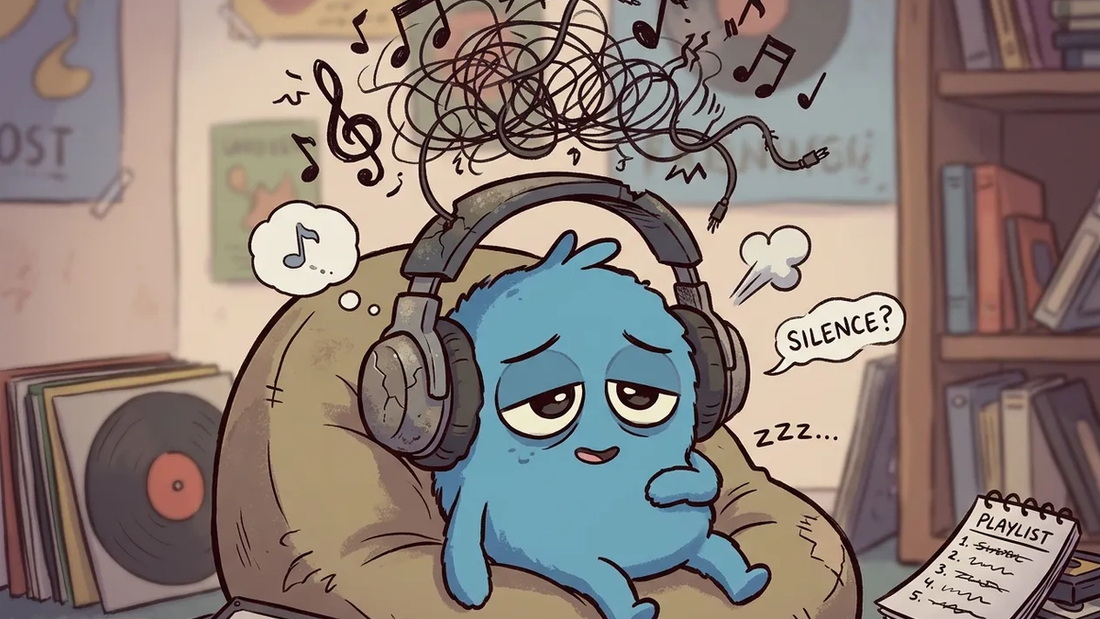
Have you ever loved a song so much that you played it 50 times? Each replay, a new lyric resonates, yet after two weeks, the excitement fades, and a new song takes over.
There is actually a scientific basis for this effect. The relationship between exposure and enjoyment follows an upside-down 'U', meaning that repetition increases appreciation to a peak; after that, we start to become bored by the same beat and lyrics. Songs need to be novel enough to hold attention, and once a song is too predictable, we develop an aversion to it.
Why Familiar Songs Start to Feel Boring
Interestingly, the depth of a song often determines how quickly we discard it. Simple, catchy "TikTok songs" tend to die quickly, while complex songs with layered production and meaningful lyrics take longer for our brains to fully understand. Each time we listen to complex music, our brain may notice something new or understand a lyric in a different way.
"Less complex music will attract more listeners initially. They will, on the other hand, sooner lose interest as their familiarity with it increases, because it was initially closer to the threshold of boredom." — Frontiers in Neuroscience.
The Role of Emotion
Furthermore, researchers at the University of Michigan found that emotionally complex songs keep listeners engaged for longer. Purely happy music is much less engaging and easier to process than music that includes mixed emotions such as love, envy, or jealousy.
The Hedonic Treadmill: Why Nothing Stays Good Forever
Overexposure or repeated listening to a song isn't just a musical problem; it's part of a broader psychological law that shapes how we engage with and connect to emotions. This law is known as hedonic adaptation. To put it simply, imagine you get a new car or a raise at work, you feel a spike of joy. Soon, the joy of that new car or raise will go away, and then you'll turn to something new, and soon, you'll get bored with that, and so the cycle continues. This is an effect known as the hedonic treadmill; our pleasure systems are running, but never actually get any happier.
Why Music Burns Out Faster Than Anything Else
Music, however, is unique in its resistance to hedonic adaptation. Unlike cars or raises, a new favorite song can appear in minutes, sometimes by chance. The entire hedonic cycle may occur in a single afternoon. Researchers found that musical boredom comes down to five things: a song that's too simple, too repetitive, too uniform, that fails to feel personal, or that's just not for you anymore. Overplaying a song can push it into any of those.
How Fast Are We Actually Burning Out?
This isn't just a problem for some people; in fact, 86% listen to their favorite song daily, 43% play it at least 3 times a day, and 60% listen several times in a row. We are speed-running boredom, likely because of the persistent emotions songs evoke. Research shows emotions from music can last up to 20 minutes after the song ends, but after overplaying, that afterglow fades.
The only real fix is one nobody wants to hear: stop listening, at least for a while. The brain needs enough distance to forget the baseline before the song can feel like anything again.
Dopamine and Music: The Chemistry of the First Time
Let's talk about dopamine, which is perhaps one of the most relevant neurochemicals in modern society, as it plays a role in drugs, social media, betting, and just about everything pleasurable that we do. The interesting piece is that dopamine is not a pleasure chemical; it's a chemical of anticipation.
The Two-Part Dopamine System
Without making this article too scientific, let's briefly dive into the two-part dopamine system that is active when listening to music. This is important for understanding how music generates anticipation and reward.
First, during the anticipation phase, the caudate nucleus releases dopamine as we reach the parts of a song we like, and the nucleus accumbens fires at the emotional climax, which serves as confirmation of what we anticipated.
Both phases of our dopamine system are highly active and uniquely powerful when a song is new. As we overplay a song, there is nothing left to anticipate because the emotional impact diminishes with familiarity.
Chills Disappear With Dopamine
One way to easily observe these dopamine-driven processes is through chills. When we listen to emotionally charged songs for the first time, think of Gideon, Adele, or your favorite vocalist, and the heaviest parts of the songs can resonate so hard that they give you chills. As we become more familiar with the song, chills often disappear.
Music, Drugs, and Tolerance
Because of this overlap with our dopamine systems, the neural response to a great song is remarkably similar to the response to cocaine. When you overplay a song, you build a tolerance that reduces your emotional response the next time you play it. A 2019 PNAS study confirmed that dopamine is the mechanism that drives musical reward.
How TikTok Makes It Even Worse
Once we add TikTok to all of this, the problem gets much, much worse.
Have you ever swiped on TikTok for too long and found that a song from a trend is stuck in your head? Most of the time, it's the songs we might hate that keep playing in our heads. The problem here is that you have unintentionally encoded the song so deeply in your hippocampus (brain's memory center) that it plays back involuntarily, on a loop.
Welcome to Involuntary Musical Imagery (INMI).
The worst part is, the more you try to push it out of your brain, the worse it gets. The harder we try not to think about something, the more a background monitoring process in the brain keeps checking whether we're thinking about it.
The Zeigarnik Effect: Why TikTok Hooks Never Let Go
The reason this connects to TikTok so much is that involuntary musical imagery happens most often in fragments, which could be a chorus, verse, or 15 seconds of a hook. Our brain treats incomplete tasks as unfinished business, forcing us to keep returning to them. Because we never get to hear the full song, our brain keeps queuing the fragment. The need to finish incomplete tasks is known as "The Zeigarnik Effect."
Ligo Inc.
At Ligo, music is never just background noise; it's how we understand people. We love exploring the psychology of music, and we're always curious about what it quietly does to us without us even realizing it.