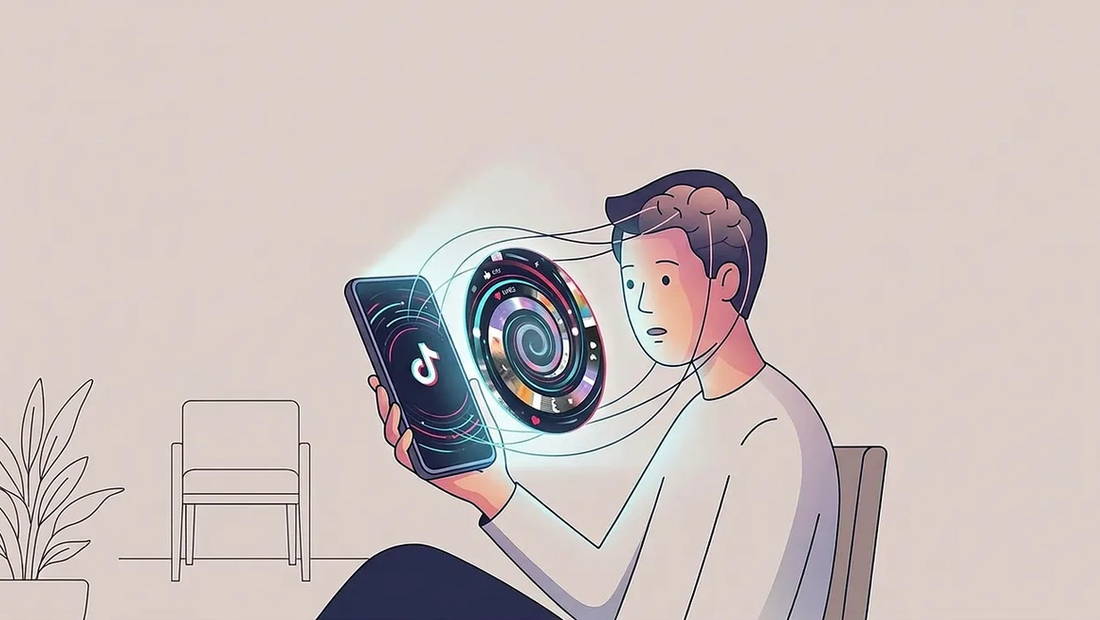
Have you opened TikTok and wondered why a video appeared on your feed? Scrolled for minutes without seeing anything related to your interests?
This is not a flaw; this is exactly how the algorithm is designed to work. At the core of this piece is a critical thesis: TikTok and similar platforms deliberately shape what you see to maximize engagement, not to reflect your true interests, but to mold them. Let me explain why this matters.
How the TikTok Algorithm Really Works
TikTok isn’t concerned with your actual interests; they’re focused on what their data suggests your interests are. As covered in our previous blog, engagement drives profit for social media platforms. TikTok’s priority is your engagement, whether it’s positive or negative.
To distinguish between what is engaging and what is genuinely interesting to an individual, we need to understand what engagement means on TikTok. TikTok’s for you page (FYP) is calculated based on thousands of macro and micro behaviors. As for macro behaviors, TikTok analyzes user interaction (likes, comments, shares, rewatches, skips), video information (captions, hashtags, sounds), and user information (device type, language, location).
People understand the macro-level data, but eerily accurate suggestions come from micro-behaviors woven into their algorithms.
Macro Signals: What TikTok Admits It Tracks
In our blog “How TikTok knows you better than your best friend,” we broke down how TikTok uses pause behavior, hesitation patterns, scroll speed, loop rate, and completion percentage. They also collect data not directly tied to scrolling behavior:
- Battery level, keystroke patterns, clipboard content
- Location data (precise GPS, not just general area)
- Face and voice data if you post or use filters
- Who you message and what you type (not just send)
The Scoring Formula Leaked from Internal Documents
One thing we didn’t discuss is the scoring formula leaked from internal documents.
Score = Predicted Like × Weight + Predicted Comment × Weight + Expected Playtime × Weight + Predicted Play × Weight
This may sound confusing, and it is. The main takeaway is that the algorithm predicts your behavior before you act, pre-ranking your feed for your next session, hoping to keep you watching longer.
TikTok Builds a Behavioral Profile on You in Under 40 Minutes
You might intentionally avoid certain videos and engage with others to change your For You Page. But the algorithm already knows you. Within two hours (sometimes less than 40 minutes), TikTok forms your behavioral profile, and you can’t change it. TikTok’s internal documents suggest a behavioral habit forms after just 260 videos, about 35 minutes of scrolling.
A 2025 neuroimaging study found that TikTok’s algorithm and its personalized recommendations trigger stronger activations of the brain’s reward system than non-personalized videos, the same pathways involved in strong addiction.
After analyzing 347 users and 9.2 million videos, a University of Washington study found that daily usage doubles within 80 days and that watch time increases. After a year, the trend worsens. They track the content you seek by emotion and know how to reach you at both your best and worst.
You’re Not the Product — You’re the Mine
The saying goes, “If a product is free, then you are the product.” With TikTok, it’s not that you’re being sold, but that your data is being extracted. The longer you use TikTok, the more specific and valuable your profile becomes. This process amounts to involuntary labor.
TikTok user data drives its value to advertisers. Ultimately, advertisers want their ads to reach the right audience. TikTok’s 2024 revenue was $23.6 billion, showing the scale and complexity of its profiles.
TikTok Isn’t Alone: Instagram and YouTube Are Only Slightly Better
TikTok gets the most attention here, but Instagram and YouTube are only slightly better. As of 2026, Instagram shifted from an algorithm based on a social graph to one based on an interest graph. Instagram now recommends content from accounts you do not follow and uses different algorithms for your homepage feed, reels, explore page, and stories. YouTube’s recommendation engine drives 70% of what users watch.
This data suggests that our feed is choosing us, not the other way around. Every time you open these apps, a highly personalized content environment has already been assembled for you, built from behavior data you generated without even realizing it.
But is personalized content really a bad thing?
What Is a Filter Bubble, and Why Should You Care?
In 2011, Eli Pariser developed a framework that anticipated exactly where we’d end up. He coined the “filter bubble”, a “personal ecosystem of information catered by algorithms.” In his book, The Filter Bubble: What the Internet Is Hiding from You, his main message was that when algorithms control what you see, they limit your exposure to new or challenging information, effectively creating parallel universes of facts.
“A kind of invisible autopropaganda, indoctrinating us with our own ideas, amplifying our desire for things that are familiar and leaving us oblivious to the dangers lurking in the dark territory of the unknown.” — Eli Pariser
That was 15 years ago. In a 2023 review of recommendation algorithms, three forces now drive filter bubbles: algorithmic bias, data bias, and cognitive bias. Algorithmic curation has increased content homogeneity by up to 60% on major platforms over the past decade. Notice it? Scroll your feed for 10 minutes; you’ll see the same hooks, formats, and styles.
Why Every Creator Sounds the Same Now
The algorithm is forcing people to make similar content. If your entire income depends on content creation or UGC, why risk something new when you can copy a format that you know is successful, rinse and repeat? What’s happening with social media is actually very similar to common criticism of the film industry. You can’t even count on your fingers the number of Fast and Furious movies there are anymore. The reason they keep making them is that, from a business standpoint, they know what to expect if they repeat the same format. This is a much safer play than taking a chance on a movie concept that’s never been done before. With social media, innovation gets punished, and imitation gets rewarded. Over time, the algorithm doesn’t just shape what we see, it shapes what gets made in the first place.
Filter Bubbles Become Echo Chambers — and That’s by Design
Filter bubbles are what algorithms do to you, narrowing the information that reaches you. Over time, they calcify into an echo chamber, environments where existing beliefs are amplified. Beliefs get rigid, your perception of what’s “normal” shifts, and you start to genuinely think that what you believe is “common sense.”
And here’s where it gets worse: a 2026 study from the University of Rochester found that echo chambers are not an inevitable byproduct of personalization; they are a simple design choice. If TikTok wanted to keep personalization without echo chambers, it could. The problem is, they don’t want to. TikTok could introduce small amounts of randomness into feeds, which has measurably reduced belief rigidity, but it hasn’t. Outrage and confirmation keep you on the app longer than intellectual diversity ever could.
The Opinion Shift You Don’t Notice Happening
Repeated exposure to biased content increases opinion shift drastically:
- Single Google search exposure: +11.5% vote preference shift
- After 2nd exposure: +20.2%
- After 3rd exposure: +22.6%
The Feedback Loop That’s Quietly Rewriting Your Preferences
This effect is called mere exposure: repeated algorithmic exposure doesn’t just reinforce existing preferences, it creates preference. Research on this phenomenon shows that we tend to develop positive feelings toward things we’re repeatedly exposed to. Algorithms exploit the mere exposure effect by gradually resurfacing content from certain creators, in certain formats, with certain aesthetics, to gradually create what feels normal or “good” without our active consent.
It’s a loop: you generate behavioral data → the algorithm builds a profile → your profile determines your content → that content shapes what feels true to you → your preferences generate new data. Each round reinforces itself. We never chose to enter; we just opened an app.
How Algorithms Are Co-Authoring Your Identity
Researchers developed the concept of the algorithmic self: a digitally mediated identity in which “personal awareness, preferences, and emotional patterns are shaped by constant AI feedback.”
This peer-reviewed paper argues that algorithms are now co-authors of the self, meaning that identity feedback loops can solidify self-concepts in ways that prevent personal evolution. The loop we talked about earlier is present here: for example, you engage with introverted or low-energy content → the algorithm labels you as such → then serves you more of it, trapping you in a digital echo chamber.
“The algorithm is aware of the things you engage with, but not who you might become.” — Frontiers in Psychology.
To algorithms, there is no concept of growth, change, or aspiration; they analyze your behavior and assume it will remain the same.
Early social media gave users agency: you chose what to follow and what to like. Now, the follow button is nearly useless. Platform goals, not personal choice, dictate the content you see.
Nearly half of Gen Z wish short-form video hadn’t become a social media staple, according to a 2024 Fortune report. The problem is that this generation finds it nearly impossible to disengage from.
The Alternative Isn’t a Better Algorithm, It’s Getting Off the Feed
So, what is the alternative? What could it look like?
The alternative isn’t just a better algorithm, a cleaner feed, or a smarter recommendation engine; it’s not even one that claims not to manipulate you. Every platform that has made such promises ultimately still optimizes for your time, attention, and data. We need to change the relationship we have with these platforms, seek agency over what we consume, and question the systems that decide for us.
The real alternative is a platform built on an entirely different premise: to make meeting in person even easier. That is the idea behind Ligo. A social app designed not to maximize screen time, but to break down the barriers that prevent us from meeting new people. No behavioral profiles assembled in the dark. No loop optimizing for engagement over your well-being. No Algorithm deciding who you are based on what you watched at midnight.
The actual thing that social media always claimed to be about: Human connection.
The algorithm has been choosing for you. It’s time to choose for yourself.
Download Ligo today.