
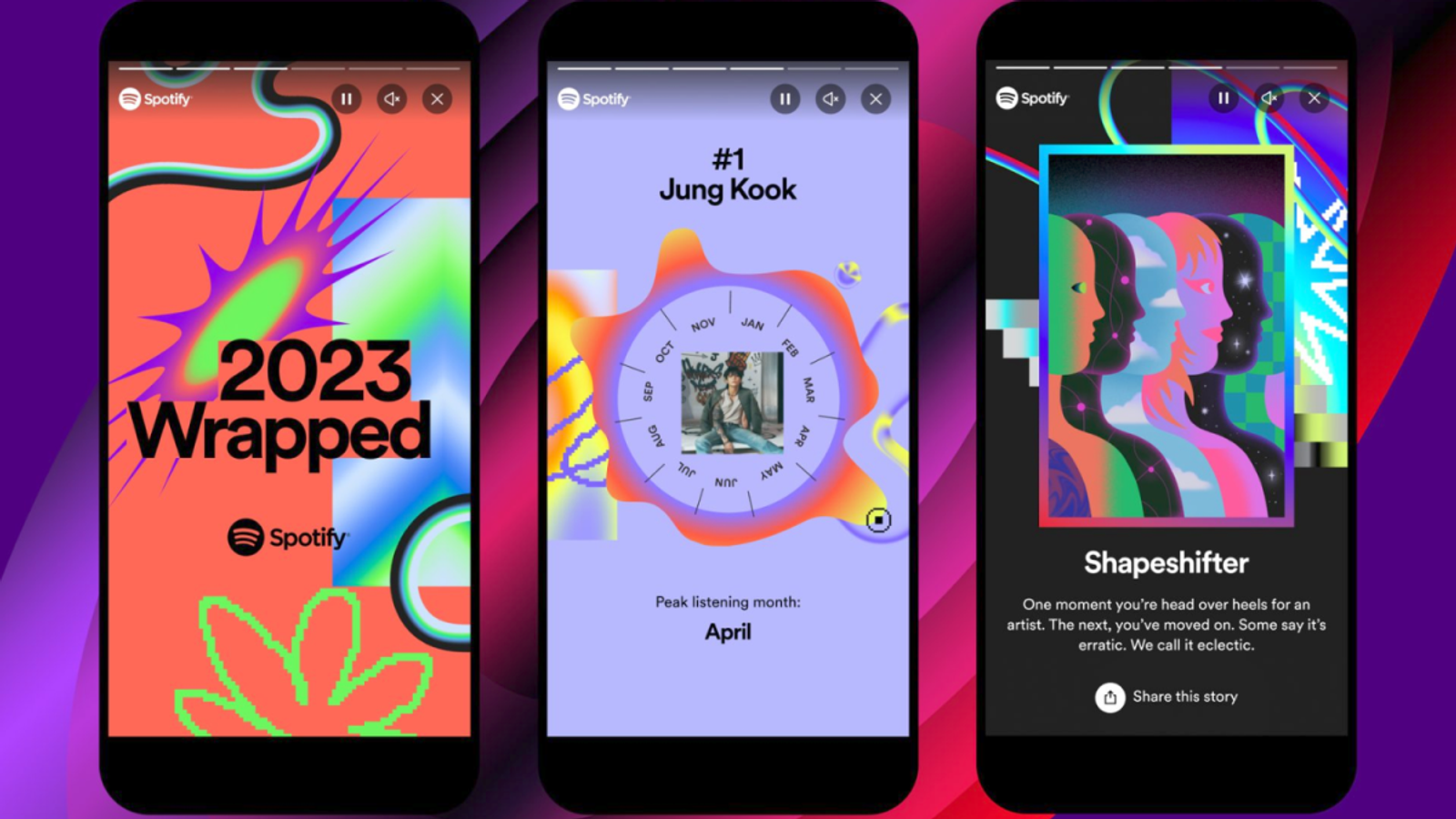
Every December, millions share their Spotify Wrapped, but why does it feel so personal? The answer is rooted in music and friendship psychology. Here's what the science says about music taste, personality, and how we find each other.
Every December, Spotify Wrapped drops, and for about a week, everyone is in the same conversation. People share their top artists, their listening hours, their whole musical year, plastered across Instagram stories for anyone to see.
But here’s what’s interesting: a lot of people won’t post it. Not because they’re not obsessed with it, most of us are, but because it feels too personal to share with just anyone.
That tension is worth paying attention to. Wrapped doesn’t feel like sharing a playlist. It feels like sharing something about yourself. And as it turns out, that instinct is backed by two decades of research in music and friendship psychology: your music taste is one of the most accurate personality signals you broadcast, usually without realizing it.
This is what Spotify Wrapped actually is. Not a year-in-review. A personality test, one you’ve been taking your whole life.
We’ve always used music to find each other, whether it’s at concerts, live music bars, or the party where someone finally put on the right song. These moments work because music does something no icebreaker can: it tells you who someone is before you’ve even met them.
Your Music Taste Reveals More Than You Think
Perhaps the reason we obsess over Spotify Wrapped is that it reveals our identity better than a personality test ever could. The field of music and friendship psychology has shown that instead of telling people you are an ENTJ or ENFP, you could simply share your Wrapped, and everyone learns about who you are.
The Four Dimensions of Music Preference
Over 20 years ago, a paper by Peter Rentfrow and Samuel Gosling at UT-Austin cited over 1,800 times remains the standard reference in this field. Across six studies with more than 3,500 participants, they found that music preferences cluster into four broad dimensions:
- Reflective and Complex: blues, jazz, classical, folk
- Intense and Rebellious: rock, alternative, heavy metal
- Upbeat and Conventional: country, soundtracks, religious, pop
- Energetic and Rhythmic: rap/hip-hop, soul/funk, electronica/dance
Each dimension maps to the Big Five personality traits — openness, conscientiousness, extraversion, agreeableness, and neuroticism:
- Reflective and Complex: correlated most strongly with Openness to Experience
- Intense and Rebellious: correlated with Openness
- Upbeat and Conventional: correlated with Extraversion, Agreeableness, and Conscientiousness; negatively with Openness
- Energetic and Rhythmic: correlated with Extraversion and Agreeableness
Empathizers vs. Systemizers — The Drake and Kendrick Split
A separate Cambridge study by Greenberg, Simon Baron-Cohen, and others (PLOS ONE, 2015) found that cognitive style (whether someone is wired to empathize or to systematize) predicted music preferences better than personality in some cases.
Empathizers are drawn to music through emotion, music that makes them feel something, not figure something out.
Systemizers are wired to analyze and decode structure, in music, that means gravitating toward complexity over feeling.
For most people, an easier comparison than mellow vs. complex jazz is Kendrick’s To Pimp a Butterfly and Drake’s Take Care. Those who appreciate more emotionally vulnerable music gravitate toward Drake; those who prefer technically dense music and lyrics that require study gravitate toward Kendrick. Behind the widely publicized beef between the two, this is perhaps why everyone has such different opinions — who you gravitate toward is not something that can be easily changed, or even changed at all.
Your Digital Footprint Is a Personality Signal
The link between shared music taste and relationships isn’t just theoretical. A 2018 study in Psychological Science by Nave, Greenberg, Kosinski, Stillwell, and Rentfrow (combined N ≈ 44,000) used real Facebook likes, not self-reports, and found that musical artist preferences predicted Big Five personality traits, especially Openness and Extraversion, above and beyond demographics. The key finding: the music-personality link is detectable in real-world digital footprints. Your Spotify Wrapped post isn’t just a fun recap. It’s behavioral data.
How Spotify Turned Your Listening History Into a Personality Test
The Listening Personality Feature
In 2022, Spotify rolled out ‘Your Listening Personality’ — explicitly modeled on personality-test conventions. According to Spotify’s own newsroom, it categorizes users along four binary dimensions (each labeled with letters, MBTI-style):
- Familiarity (F) vs. Exploration (E): repeating favorite artists vs. sampling new ones
- Loyalty (L) vs. Variety (V): playing the same tracks on repeat vs. cycling through many
- Timelessness (T) vs. Newness (N): older catalog vs. brand-new releases
- Commonality (C) vs. Uniqueness (U): popular artists vs. obscure ones
Combining the four dimensions yields 16 possible types — the Adventurer, the Specialist, the Time Traveler, and so on. The MBTI parallel is intentional in the visual design, though Spotify has never claimed parity with formal personality testing. In 2024, Spotify followed this up with ‘Your Music Evolution’, dividing the year into up to three named ‘musical phases’ generated by machine learning.
Why Sharing Your Wrapped Feels Personal
The science behind this goes deeper than the interface. In 2021, Spotify’s own peer-reviewed research paper — published in Social Psychological and Personality Science with Cambridge’s David Greenberg as a co-author — analyzed 17.6 million songs and 662,000+ hours of listening from 5,808 Spotify users. Machine learning models predicted Big Five personality traits from streaming data with moderate to high accuracy. The two traits most strongly predicted: Emotional Stability and Conscientiousness.
Spotify didn’t accidentally make a personality test. They built one intentionally, using your listening history as the data set. And they’ve been peer-reviewing the results.
Spotify Wrapped Is One of the Last Real Cultural Moments
What a Cultural Moment Actually Requires
The strength of the music-personality link is still debated, while Spotify’s behavioral data studies found moderate to high accuracy. Both sides have a point. But here’s what isn’t debated: Spotify Wrapped has become one of the few genuine cultural moments we have left.
Think about what a cultural moment actually requires: millions of people experiencing the same thing, at the same time, and wanting to talk about it. That used to happen regularly. A new hit movie would come out, and the only way to see it is in theaters. By sunday, everyone would have seen it. A season finale would air, and everyone was talking about it on Monday morning.
Why Wrapped Works When Everything Else Fragmented
That era is largely over. Streaming fragmented movies and TV into a thousand individual queues. Nobody watches the same thing anymore. But every December, Spotify Wrapped drops, and for about a week, everyone is in the same conversation.
Spotify has successfully engineered a cultural moment everyone wants to be part of — that’s the genius behind Wrapped. As Marcus Collins, a marketing professor at the University of Michigan, told NPR: “Wrapped is a way by which we’re able to project our identity based upon our cultural consumption.” This is why music creates connection even across a screen — it gives people a reason to feel like sharing it means something.
This goes back to Rentfrow and Gosling’s 2006 follow-up paper, which found that music was the single most common topic in get-acquainted conversations between strangers — and that strangers could form accurate impressions of someone’s personality from a top-10 song list alone. People have been using music as a social signal for centuries. Wrapped just industrialized it.
Wrapped Is How We Make Hot Takes Without Knowing It
Spotify Wrapped is also how people make hot takes without knowing it. Simply sharing your Wrapped is an implicit claim: these are the best artists, this is what good music sounds like. When I see certain people’s Wrapped, I won’t lie, my first reaction is genuine confusion. But that’s exactly the point. When we argue about music, we think we’re debating taste. We’re actually debating personality. We just don’t have the vocabulary for it yet.
Music Has Always Been How We Find Each Other
Bonding over music has always been how we communicate personality without saying a word. Every party with a great DJ, every live show at a bar, every album listening party: these are the moments where people find each other. Not because they planned to, but because the music already told them who was in the room.
That’s exactly what we want to create at Ligo. College is the most important part of our musical and social lives, so it only makes sense that we combine the two.
On Ligo, your music taste finds your people, and then gives you a real place to meet them.